


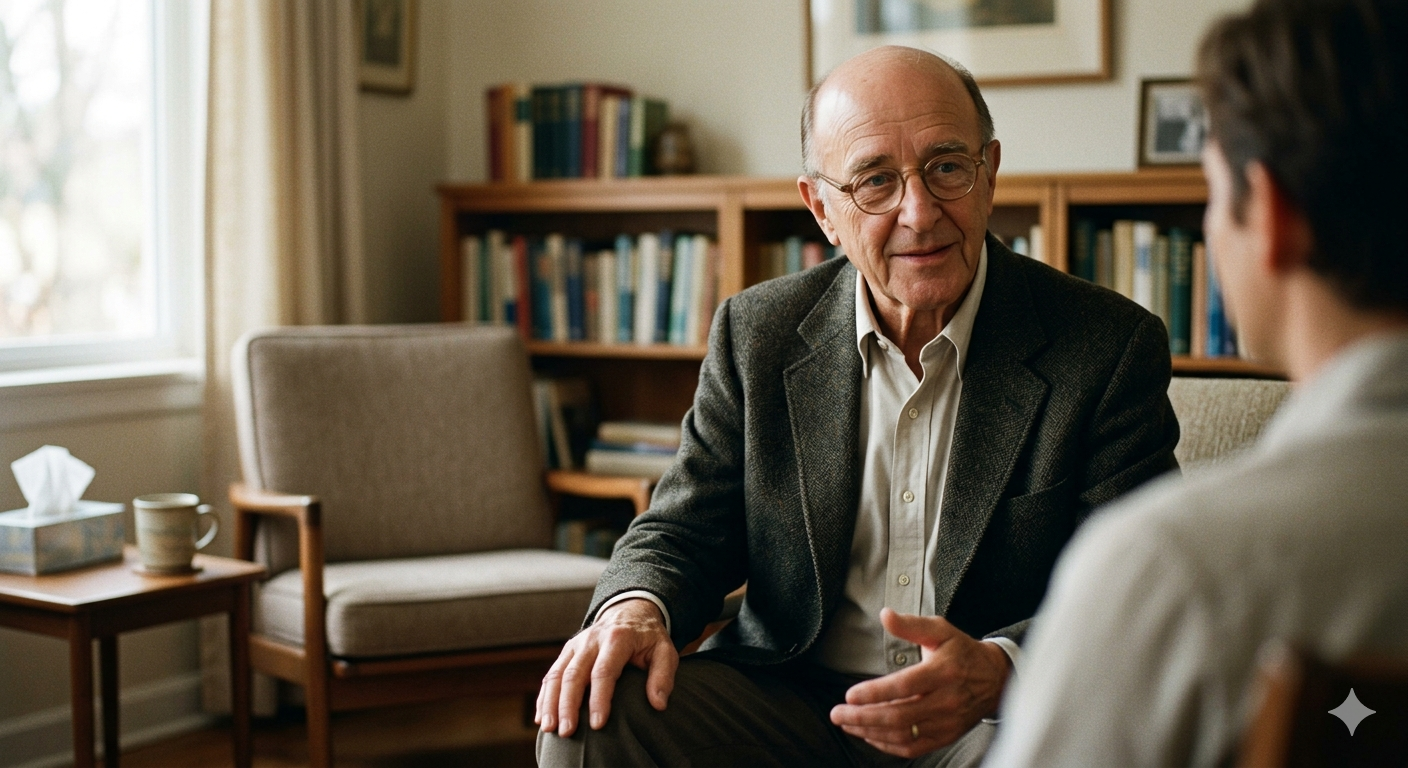
Carl Ransom Rogers (1902–1987) was a pioneering American psychologist whose work transformed the field of psychotherapy and introduced a new way of understanding human potential. Widely recognized as one of the founders of humanistic psychology, Rogers developed the person-centered approach, a revolutionary method emphasizing empathy, personal growth, and the innate capacity of individuals to find their own solutions. His theories have influenced not only counseling and therapy but also education, leadership, conflict resolution, and personal development worldwide.
Early Life and Education
Carl Rogers was born on January 8, 1902, in Oak Park, Illinois. He grew up in a strict, religious, and structured household, which he later described as rigid and sometimes stifling to emotional expression. Initially interested in agriculture, Rogers shifted his focus to theology before finally choosing psychology, drawn by his fascination with human behavior and interpersonal relationships. He completed his doctoral studies in clinical psychology in 1931, setting the stage for a career that would challenge conventional psychological theories and promote a humanistic view of human nature.
Humanistic Psychology: A “Third Force”
During the mid-20th century, psychology was dominated by two major schools: behaviorism, which focused strictly on observable behaviors, and psychoanalysis, which emphasized unconscious drives and childhood experiences. Rogers, along with Abraham Maslow, introduced humanistic psychology, often called the “third force” in psychology. This approach centered on the belief that humans are inherently good, capable of self-understanding, and motivated to grow toward self-actualization—the process of realizing one’s full potential. Humanistic psychology emphasizes subjective experience, personal choice, and the value of empathy and understanding in fostering psychological well-being.
Person-Centered (Client-Centered) Therapy
Carl Rogers is most famous for developing client-centered therapy, later called person-centered therapy. This was a radical shift in psychotherapy because it positioned the client—not the therapist—as the primary agent of change. Rogers believed that individuals possess the internal resources for growth, healing, and problem-solving, and that the therapist’s role is to provide a supportive environment that fosters self-exploration.
Core Principles of Person-Centered Therapy
Rogers identified three critical conditions necessary for effective therapy:
- Empathy – The therapist listens deeply, strives to understand the client’s perspective, and reflects that understanding back, helping the client feel genuinely understood.
- Unconditional Positive Regard – The therapist accepts the client without judgment, offering support and understanding regardless of the client’s thoughts, feelings, or behaviors. This creates a safe space for self-expression.
- Congruence (Genuineness) – The therapist is authentic, honest, and transparent, modeling emotional openness, which encourages the client to explore and express themselves authentically.
Unlike traditional therapies, Rogers’s method is non-directive. The therapist does not give advice or interpret the client’s experiences but facilitates self-discovery by asking open-ended questions and reflecting the client’s thoughts. By replacing the traditional label of “patient” with “client,” Rogers emphasized respect, autonomy, and human dignity, highlighting that therapy is not about fixing a defect but supporting growth.
The Fully-Functioning Person
A central concept in Rogers’s theory is the idea of the fully-functioning person—someone who is self-aware, open to experience, and capable of living authentically. Fully-functioning individuals trust their inner experiences, remain open to both positive and negative aspects of life, and align their self-concept with their actual experiences. Psychological distress often arises when there is incongruence—a conflict between one’s self-image and actual experiences. Therapy, according to Rogers, helps reduce this incongruence, allowing people to move toward self-acceptance, personal growth, and fulfillment.
Applications Beyond Therapy
While Rogers’s work originated in psychotherapy, its principles have been applied in numerous other fields:
- Education: Rogers’s humanistic approach influenced learner-centered education, emphasizing autonomy, experiential learning, and emotional support. Teachers are encouraged to create environments where students feel respected, understood, and motivated to explore knowledge independently.
- Organizational Leadership: His principles of empathy, authenticity, and empowerment have informed leadership training, team building, and organizational culture, helping create workplaces that encourage open communication and collaboration.
- Conflict Resolution: By applying his concepts of empathy and unconditional positive regard, mediators and leaders can promote understanding, reduce tension, and facilitate constructive dialogue.
- Positive Psychology: Modern positive psychology, focusing on human strengths and well-being, draws on Rogers’s ideas about self-actualization and the natural tendency toward growth.
Critiques and Evolution
Despite the widespread influence of Rogers’s approach, some critics argue that pure person-centered therapy may be too non-directive for clients who need structured guidance or practical skills. Contemporary therapists often integrate Rogers’s principles with other therapeutic methods to provide both emotional support and practical strategies for problem-solving. Nonetheless, Rogers’s emphasis on the quality of the therapeutic relationship and the importance of empathy, authenticity, and acceptance remains a foundational concept in psychology.
Legacy and Contributions
Carl Rogers authored numerous influential books and articles, including Client-Centered Therapy, On Becoming a Person, and A Way of Being. He served as President of the American Psychological Association and received global recognition for his contributions to mental health and human development. Rogers’s work not only transformed psychotherapy but also shaped education, leadership, and personal growth practices worldwide. He demonstrated that by creating an environment of understanding, acceptance, and empathy, humans can realize their potential and lead meaningful, authentic lives.
Conclusion
Carl Rogers remains one of the most influential figures in psychology. Through his pioneering humanistic and person-centered approach, he emphasized the dignity, potential, and inner resources of every individual. By promoting empathy, unconditional positive regard, and authenticity, he revolutionized therapy and influenced fields as diverse as education, leadership, and personal development. Rogers’s legacy endures in modern psychology and beyond, reminding us that the path to growth and fulfillment lies within each individual and that a supportive, understanding environment can unlock that potential.
